My intention last year was to cultivate the habit of reading instead of spending hours on my phone AND expanding my literary tastes, reaching beyond my Anglo-American horizon. Overall, I’m very happy with the result – I definitely read more in 2025, discovered new authors and new books by those I already love. Some texts were impulsive purchases, some I grabbed at random from the library, others have been on my reading list forever, and finally some were recommendations or gifts.
Things that definitely helped me read more this year were:
- Bringing my book with me everywhere – I read on my commute, in the changing room before gym, at lunch, outside and indoors.
- Dedicating some time after work to read in a pleasant spot – I’d go to the neighborhood library or to the park after leaving the office, just to read.
- Switching frequently between paper and digital, owned and borrowed books.
- Not finishing things that did not interest me.
- A reading journal. I took notes after finishing each book to keep track of the quotes I found particularly impactful and my impressions.
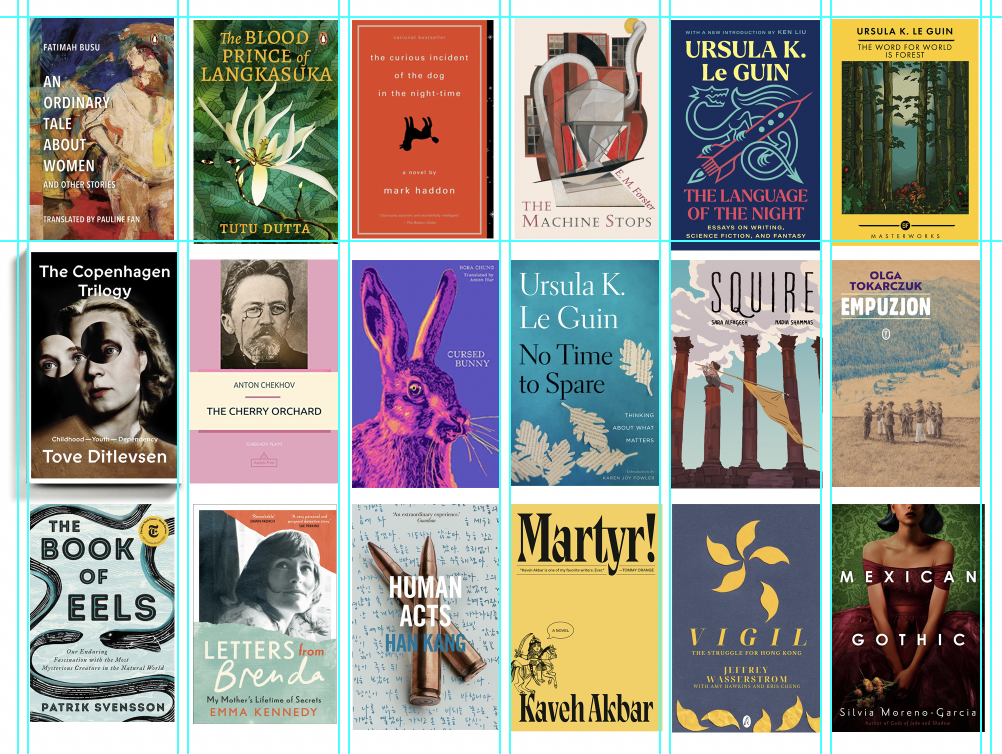
Overall, I read over 30 books last year and I can recommend all of them. Listed below, in three categories and no particular order within them, with the notable mention of three that impacted me deeply.
My absolute Top 3 this year:
- The Language of the Night: Essays on Fantasy and Science Fiction (1979) by Ursula K. Le Guin. Life-changing. I forgot one can feel such kinship with another human being just by reading their thoughts, even when separated by a few decades. While the format might be off-putting to some people (few reach for collections of literary essays and forewords to already published novels), Le Guin’s sharp intellect and sense of humor make this publication a real gem.
- The Word for World is Forest (1972) by Ursula K. Le Guin. As relevant now as it was in the 1970s. Written by Le Guin in reaction to the Vietnam War, out of frustration of being unable to protest in any meaningful way while living in London.
- Human Acts (2014) by Han Kang. Nobel prize well deserved. Brutal, violent, but also tender, reminding the readers that democracy was paid for with blood and suffering. Something worth repeating today, when many take their rights and freedoms for granted while others struggle to maintain their sovereignty and lives.
Fiction
In no particular order – I loved all these novels, short stories, and plays
- The Word for World is Forest (1972) – Ursula K. Le Guin. Emotionally devastating exploration of wounds inflicted by colonialism and occupation. Incredibly relevant in the context of today’s armed conflicts.
- Project Hail Mary (2021) – Andy Weir. The kind of optimistic science-fiction I love: people overcoming their differences and teaming up to solve problems, friendships in space, competent project management and excellent engineering. Audiobook version is superior to the written word for a very specific, plot-related reason.
- “The Machine Stops” (1909) – E. M. Forrester. Prescient. This short story is considered to be one of the founding works of dystopian fiction.
- The Chosen and the Beautiful (2022) – Nghi Vo. I discovered this author during the pandemic and her imaginative twists on well known stories or tropes always bring me a lot of joy. This particular novel is a retelling of The Great Gatsby, told from the perspective of a supporting character.
- Siren Queen (2023) – Nghi Vo. A fantastical take on the Golden Age of Hollywood.
- Wuthering Heights (1847) – Emily Brontë. Incredible that such a complex, sensual, and emotional story of generational trauma and abuse was penned by a young woman with relatively little exposure to the world outside of her village.
- Nipponia Nippon (2001) – Kazushige Abe. A fever dream of a story, written from the perspective of a Japanese incel.
- Marina (1999) – Carlos Ruiz Zafón. Listened to an audiobook version of this one in Spanish, to practice. It’s a speculative fiction young adult novel, with entertaining plot and a language that was easy to follow.
- Butter (2017) – Asako Yuzuki. I wrote about it here.
- Human Acts (2014) – Han Kang. A multi-dimensional look into the Gwangju Uprising, a series of student-led demonstrations in South Korea in 1980, violently suppressed by the military.
- Perfection (2022) – Vincenzo Latronico. A short satirical novel about the ennui of a certain type of big city older millennial. The kind of satire that makes you ask “Wait. Is this fucking play about us?”.
- Empuzjon (2022) – Olga Tokarczuk. Read this one in its original Polish version, but I’m glad to see that translations are available around the world, even here in Singapore. Another great work by Tokarczuk, one of my all-time favorite writers.
- The Curious Incident of a Dog in the Nighttime (2003) – Mark Haddon. Gifted by a dear friend, this book waited on my shelf for close to two years. A delightful, thoughtful novel – I understand now why my friend has gifted it to many people in her life.
- Martyr! (2024) – Kaveh Akbar. This book starts as something and ends as something else. It’s a novel about reconciling one’s past and one’s present, about how art and freedom need each other to exist, about living and loving through grief. The author is a poet and it really shines through this unique text.
- The Blood Prince of Langkasuka (2020) – Tutu Dutta. An ancient legend from Malaysia takes a new form in this vibrant, tropical horror story.
- An Ordinary Tale of Women (2024) – Fatimah Busu. A collection of short stories by a Malaysian novelist and academic, revered in her home country but unknown abroad. Mixing realism and fantasy, social critique and religious themes, Busu paints a complex picture of the reality of Malaysian life, with special focus on the weakest and most vulnerable, women and children.
- Mexican Gothic (2020) – Silvia Moreno-Garcia. Would make for a perfect Guillermo Del Toro movie. Spooky, stylish, a little sentimental, with an action-packed climax.
- Cursed Bunny (2017) – Chung Bora. A collection of short stories, technically speculative fiction, mostly horror-adjacent. Accidentally, the author specializes in Eastern European literature and knows my country well enough to make it the setting of one of her stories.
- The Cherry Orchard (1903) – Anton Chekhov. Watched a modern adaptation of this play at the Esplanade Theater in Singapore, in Korean and with a Korean cast, so had to read the original play and compare.
Non-Fiction
- The Language of the Night: Essays on Fantasy and Science Fiction (1979) – Ursula K. Le Guin. No notes, best read of the year.
- No Time to Spare. Thinking About What Matters (2019) – Ursula K. Le Guin. Available online as an archived blog, this collection of essays allowed me to learn more about Le Guin as An Author, but also A Mother, A Reader, and A Concerned Citizen.
- Letters from Brenda (2022) – Emma Kennedy. A bittersweet book, based on a suitcase full of old letters and the author’s memories of her mother. It asks how well one can know one’s parents and how does one reconcile different versions of them in one’s heart.
- The Copenhagen Trilogy (Childhood, Youth, Dependence) (1967 to 1971) – Tove Ditlevsen. The most famous writer I’ve never heard of, a key figure in Danish literature, a tragic drug addict. Ditlevsen’s autobiography shows the cost of women’s emancipation in the early 20th century’s Denmark.
- The Ministry of Guidance Invites You To Not Stay (2014) – Hooman Majd. Read this around the time when the U.S. started escalating tensions with Iran. The author takes great care to show contemporary events in a wider context, but he also zooms in on everyday life in Tehran, the ordinary and the quotidian, with its annoyances and joys.
- Hałas (eng. Noise) (2024) – Małgorzata Halber. A collection of essays about the noise that accompanies our day-to-day lives and has a detrimental effect on our well-being. The author classifies various conditions as different types of noise, from acoustic discomfort through visual clutter of big cities to work-related worries and social concerns. It’s equal parts a cry for help and an attempt to diagnose the illness caused by living under late stage capitalism in a large European city.
- The Book of Eels (2021) – Patrik Svensson. Eels are more mysterious that you’d think, we’ve only learned more about them quite recently, and there are things about them that we’ll likely never know. A quiet meditation on the mysteries of nature.
- The World Beyond Your Head. On Becoming an Individual in an Age of Distraction (2016) – Matthew B. Crawford. A philosophical investigation of how attention shapes the Self, and how maintaining control over our focus can lead to a better life.
- What Makes Life Worth Living: On Pharmacology (2013) – Bernard Stiegler. Another heavy philosophical text on my reading list, this time about how “technical objects” can be both the cause of our suffering and also what makes life worth living.
- Vigil. The struggle for Hong Kong (2025) – Jeffrey Wasserstrom. A short book summarizing the key events in the history of Hong Kong and offering a (mostly western) perspective on the changing political landscape of the city and the recent crackdown on pro-democracy protests.
Graphic Novels
- Alison (2023) – Lizzy Stewart. A fictional story of a woman who decides to stop being a muse and becomes an artist herself.
- Squire (2022) – Nadia Shammas (Author), Sara Alfageeh (Author, Illustrator). A story of identity, exclusion, war, and bravery, set in a vibrant world. I especially liked a section at the end of the book, detailing artists’ research and their creative process.
- FUN: Spies, Puzzle Solvers, and a Century of Crosswords (2017) – Paolo Bacilieri. An incredibly entertaining book mixing real-life facts and trivia about crosswords with a fictional story.
 | on books and other things |
Leave a comment